Skip to content
Beta preview · Departmental invitations in preparation
Echem

Built around your electrochemistry

Explore the signal.
Understand the chemistry.

A connected workbench for electrochemical analysis, physical modelling and interpretation. Turn measurements and models into organised, traceable research across techniques.

Designed for researchers studying redox processes, interfaces and materials.
The first departmental beta will focus on CV and EIS.

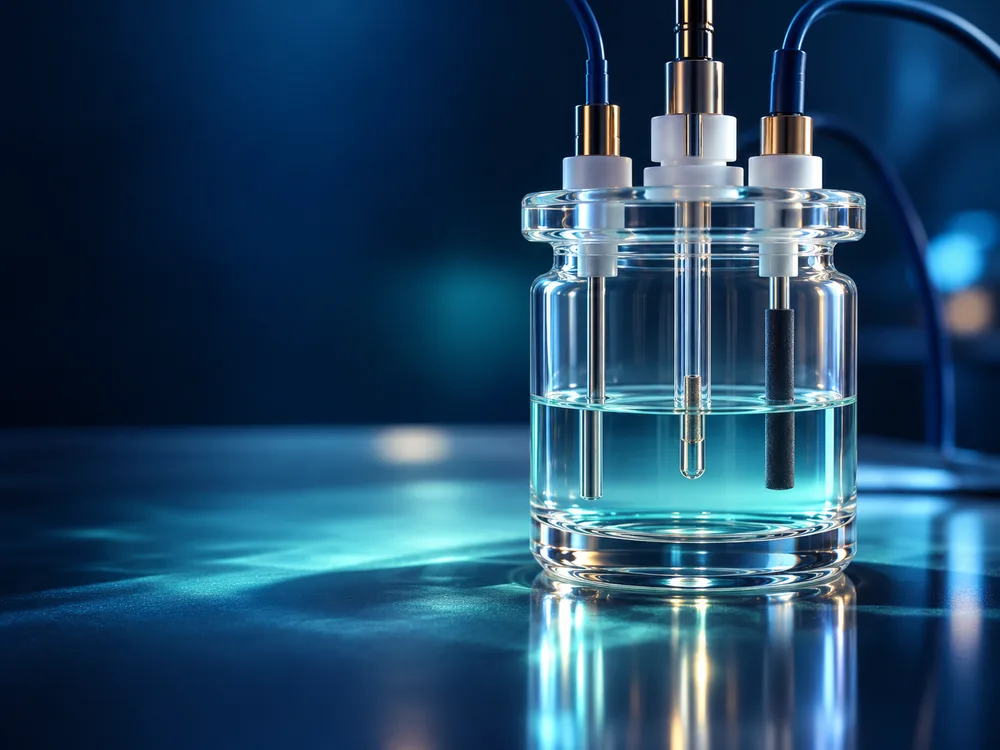
Conceptual electrochemical cell with glass, electrodes and blue instrument leads
Electrochemistry concept visual
Connected techniquesOne connected research workflow.
Physics with experimental context

Relate models to your electrode, conditions and measured response.

Interpretation you can inspect

Bring model curves, residuals and parameter context into the same review.

A continuous research workflow

Move from data to saved setups, results, exports and contextual learning.

Explore the product

Choose the work you want to do.

A quick tour. No upload required.

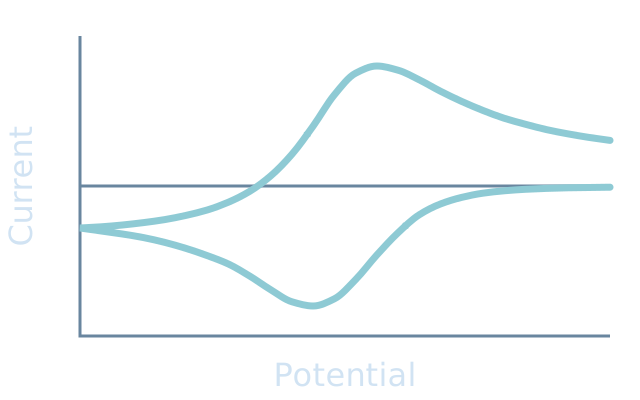
Illustrative reversible CV with distinct cathodic and anodic peaks and scan-direction arrowsCyclic voltammetry

Cyclic voltammetry

Connect the redox response to your experiment.

Explore peaks, compatible scan-rate studies and supported physical models while keeping inputs and result context together.

Peak readoutsPhysical modelsSaved research context
Open the illustrative CV result →

Illustrative result. Candidate features are subject to accepted scope.

CV tour selected

Inside the first beta

Explore more of what your measurements can tell you.

Explore techniques and modules →
CV · CYCLIC VOLTAMMETRY

Connect redox behaviour to physical models.

Bring peak readouts, scan-rate studies and full-current analysis into one research workflow.

  • Peak metrics and comparisons across compatible scan rates
  • Butler–Volmer fitting and comparison of declared reaction hypotheses
  • Model curves, residuals and parameter intervals where supported
EIS · IMPEDANCE SPECTROSCOPY

Explore interfaces across frequency.

Review impedance data and registered circuit models with the context needed to interpret a fit.

  • Nyquist and Bode views with equivalent-circuit fitting
  • Kramers–Kronig consistency checks and fit residuals
  • Parameter uncertainty, saved results and traceable exports

The workbench guides you to compatible methods using your dataset and experimental conditions.

Where Echem Suite adds value

More connected science. Less fragmented work.

Geometry-aware modelling

Work with physical models that account for electrode geometry, transport and reaction conditions.

Compare explanations

Review compatible reaction hypotheses and their fitted responses together, with parameter support and residuals in view.

Keep the experiment attached

Preserve original data, named setups and the context of saved results, making work easier to revisit and share.

Grow within one workbench

Connect analysis with learning, then explore new techniques and modules around the same research records.

One connected product family

Analyse. Understand. Keep learning.

See the full product direction →
Research workbench

Echem Suite

Explore experimental responses with physical models, inspect parameter context and organise your research across a growing family of electrochemical techniques.

Explore the workbench →
Learning preview

Echem Learn

Build technique knowledge through guided lessons, interpretation practice and clearly labelled teaching simulations.

Preview the learning connection →
Product direction

A foundation that grows

Discover connects molecular and application design. Evidence brings literature and method intelligence. Pulse connects the wider electrochemistry community. New modules will join the product family as they develop.

Explore the roadmap →

A natural research workflow

Start small. Keep the whole experiment in view.

Bring in a dataset

Start in your Inbox. Organise it into a project when that helps you.

Choose a compatible method

Confirm required experimental inputs. Open advanced controls when you need them.

Review and return

Save your setup and result, explore the interpretation and return to the same analysis later.

Help shape a better electrochemistry workflow.

We are preparing an invitation-only departmental beta for 50–60 participants. Explore the products and examples ahead of the first testing round.

Access status ↗